



To distinguish between different lithologies by Vp, SIGMA and AAI estimation requires the lithologies to have different and distinct co-ordinates in the 3-D space, even after allowing for the uncertainty bars (figure 3). The dimensions of the uncertainty bars are typically 250m/s for Vp, 0.05 for SIGMA and 500(m/s)(gm/cc) for AAI. Ideally, lithology and fluid prediction would be concerned with defining the separation of the different lithologies in all three directions of the 3-D space. However, the separation of the co-ordinates of the different lithologies may be more significant in one or two directions. Therefore, the lithologies may be distinguished by the estimation of one or more of these parameters. The separation relative to the uncertainty bars determines the effectiveness of the estimation of the different parameters to distinguish lithology.
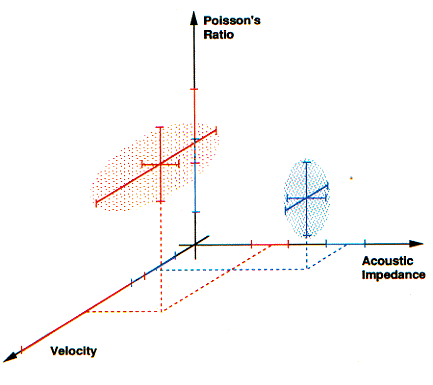
Figure 3 : Definition of Layer properties in terms of P-wave velocity (Vp), Poisson's ratio(SIGMA) and Absolute Acoustic Impedance (AAI). The co-ordinates of two different lithologies are indicated with the associated uncertainty bars of the estimates.

home |

next |

section contents |